One of the traditions that can be found in some Western and Eastern printmaking schools and Eastern Calligraphy traditions to have a personalized chop or hanko (Japan) to either seal or emboss an artists work along the margins.
This project will introduce students to a historical tradition of the of some artistic professions.
Linocut is a reductive printmaking process, which means our images are created by cutting away what we DON'T want. It is a process that forces us to consider the negative and positive space at once.
If students have missed the demonstration they can view the Lino Printing video here.


Specific Materials Needed:
Consumables:
-
Stiff Lino block 1 1/2 Inch by 3 7/8 Inch
(A 4 x 6 Lino block can be divided into three with minimal waste) -
1 1/2 inch x 2 3/8 inch wood for handle
-
Paper and Carbon paper (Image design and transfer
-
Wood Glue
Reusable:
-
Carving tool
-
Carving bench hook
-
ink pads
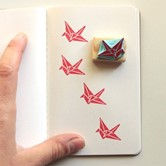
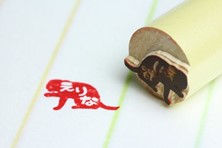
Students will need to design an image that is representative of themselves. The purpose of a chop is that the image should be unique to the individual. That could be something as simple as a stylized version of their signature in English or their another language they know, or something that represents them more abstractly. Some examples are provided here.
Important things for students to keep in mind:
Fine lines work better in the negative space than the positive. (See examples)
Images will stamp reverse of how they are carved. (See examples)


Accommodations:
Softer lino should be made available for students with fine motor control issues.
Students could also work slightly larger if needed.
Teacher can also provide opportunity for students to design larger then shrink down in photocopier (reduction).
Variations:
Students more familiar with printmaking can add complexity by creating two designs, adding design elements to the handle portion.
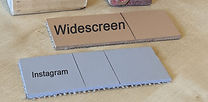
Students could also work in either the standard "Instagram" square format or switch to a widescreen format, using the long side of the handle as the width measurement.
ART 10 COMPOSITIONS:
Components 1:
EXTEND THEIR KNOWLEDGE OF AND FAMILIARITY WITH THE ELEMENTS AND PRINCIPLES OF DESIGN THROUGH PRACTISE IN COMPOSING TWO- AND THREE-DIMENSIONAL IMAGES.
B. Positive and negative space are essential to the description of two- and three-dimensional forms.
ART 20 ENCOUNTERS:
Impact of Images:
ACQUIRE A REPERTOIRE OF VISUAL SKILLS USEFUL FOR THE COMPREHENSION OF DIFFERENT ART FORMS.
Concepts:
C. Throughout history, a wide range of media and techniques have been used to make art.
ART 30 ENCOUNTERS:
Impact of Images:
QUESTION SOURCES OF IMAGES THAT ARE PERSONALLY RELEVANT OR SIGNIFICANT TO THEM IN CONTEMPORARY CULTURE.
Concepts:
B. Imagery can depict important aspects of the student’s own life.